Main activities
The project is a three-year project divided into four main activities.
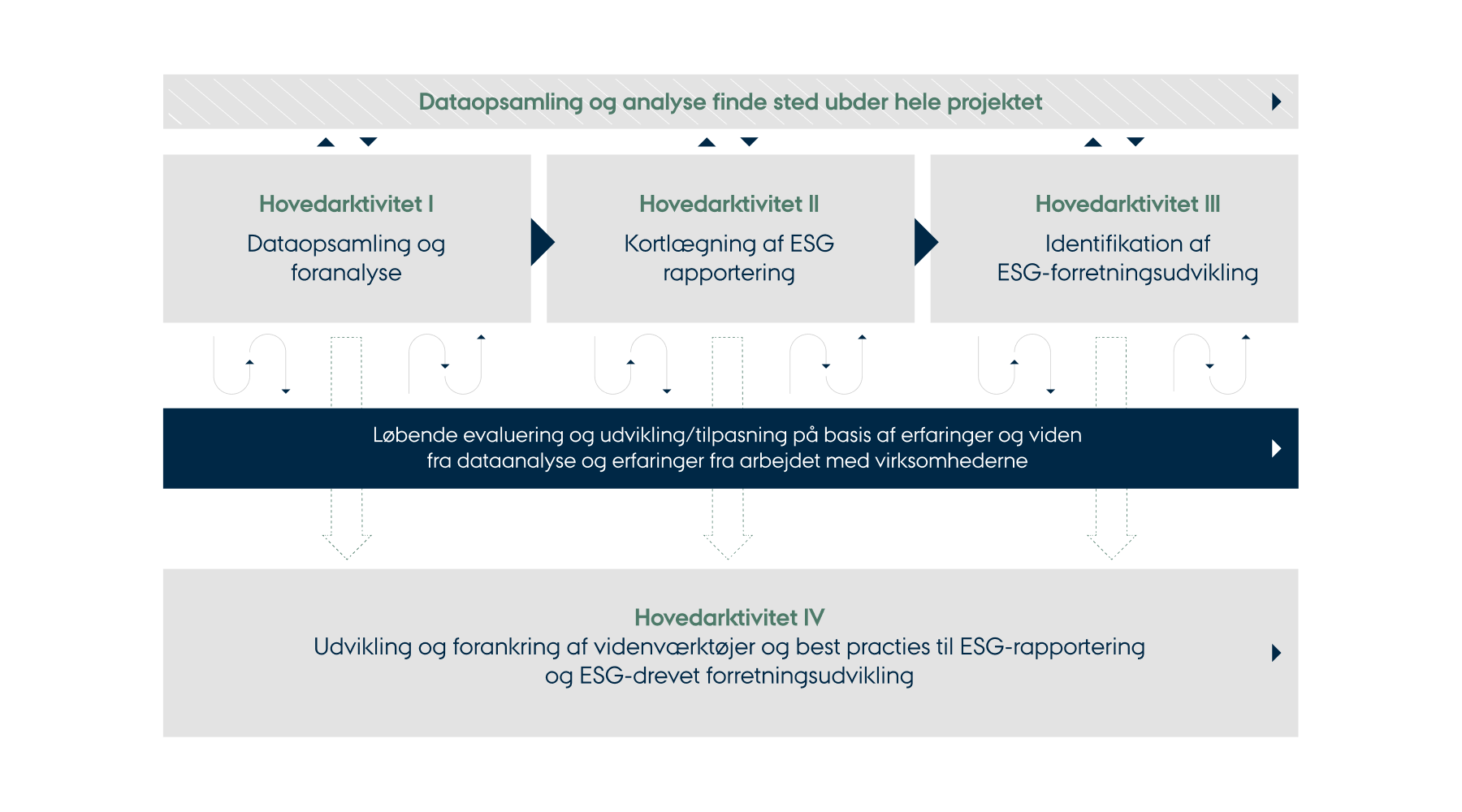
Main activity I
Data collection and pre-analysis of the value chain and ESG maturity
Data collection and analyses are carried out from the project start on 1.2.2024 and continuously throughout the entire project period.
Initially, the 5 most critical SME sub-suppliers of the 5 large companies participating in the project are identified. More specifically, an initial workshop is held where the maturity level and specific ESG challenges are identified, and a mapping is carried out of needs in relation to the value chain’s requirements for ESG reporting. In this way, the cohesion in the value chain is made clear and alignment and coordination of expectations between the customer companies and their sub-suppliers is enabled.
The continuous collection of knowledge and experiences, as part of the project’s accompanying research throughout the entire project period, forms the basis for the development of best practices and valuable tools for working with ESG.
The deliverable from main activity I thus constitutes knowledge about the SMEs’ and value chains’ maturity and specific challenges in relation to ESG reporting.
Main activity II
Mapping of ESG reporting
The purpose of main activity II is to support the project’s participating companies in preparing ESG reports.
The main activity includes a mapping of ESG reporting for each of the 25 SME sub-suppliers. During the process, the companies are also guided on where they can effectively reduce their own CO2 emissions within the company. The knowledge collected in this activity forms the basis for the development of the project’s tools, webinars and best practices and is made available as open source for all Danish SMEs and stakeholders.
The deliverable from main activity II is a mapping of best practices in ESG reporting as well as the development of a CO2 calculation model that follows the Cradle-to-gate principles in relation to calculating CO2 at product level, which can support Danish SMEs in their ESG reporting.
Main activity III
Development of tools for ESG-driven business development
The purpose of main activity III is to use experience and knowledge from the preceding activities for the development of tools, webinars and best practices for ESG-driven business development.
More specifically, workshops are held with all SME sub-suppliers, where opportunities for ESG-driven business development are mapped for each individual company.
During this process, important and actionable knowledge is gathered through dialogue, observations and interviews with the companies in order to understand their most pressing business challenges with ESG and the unique opportunities that arise in working with ESG-driven business development.
The deliverable from main activity III is a mapping of ESG-driven business development and best practices, as well as knowledge tools (guidelines, models and dialogue tools) in this area, which all Danish companies can access and use in their own ESG-driven business development and in the work of moving from ESG reporting to real ESG-driven business development.
Main activity IV
Development and anchoring of tools and best practices
In main activity IV, based on main activities I, II and III, the final tools for effective ESG reporting and ESG-driven business development in SMEs are developed. All tools are communicated as open source and can be used on all platforms to train Danish SMEs and value chains in the work of effective ESG reporting and ESG-driven business development.
The deliverable from main activity IV is the anchoring and dissemination of the project’s best practices on ESG reporting and ESG business development and knowledge tools (ESG Mat, ESG dialogue tools, Cradle-to-gate calculation model and guidelines), which all Danish companies can access and use in their own work with ESG reporting and ESG-driven business development.
Main activity IV is thus aimed at creating concrete tools, resources and knowledge that can strengthen Danish SMEs’ sustainability practices and ESG work both during the project and far into the future.